Clinical evidence & user stories
The science. The stories. The evidence.
Oprimaze was built around a documented physiological problem. These are the peer-reviewed studies that define it — and the real journeys of people navigating it, shared in their words.
Clinical evidence
Four numbers that define the problem.
These figures are not Oprimaze trial data. They're published peer-reviewed outcomes that show why a two-phase approach makes biological sense.
80%.
Regain within 5 years
Adults who lose ≥10% body weight without ongoing structured maintenance regain the majority within five years.
— Wing & Phelan, Am J Clin Nutr, 2005
2×.
Hunger hormone surge
Appetite-stimulating hormone levels remain about twice their pre-diet baseline a year after weight loss.
— Sumithran et al., NEJM, 2011
67%.
Discontinuation at 1 year
A majority of people on injectable therapy do not continue at one year — exposing them to the regain window with no structured alternative.
— Gleason et al., J Manag Care Spec Pharm, 2024
⅔.
Regain post-injectable
About two-thirds of weight lost on injectable therapy returned within 12 months of stopping in a controlled clinical trial.
— Wilding et al., Diabetes Obes Metab, 2022 (STEP 1 extension)
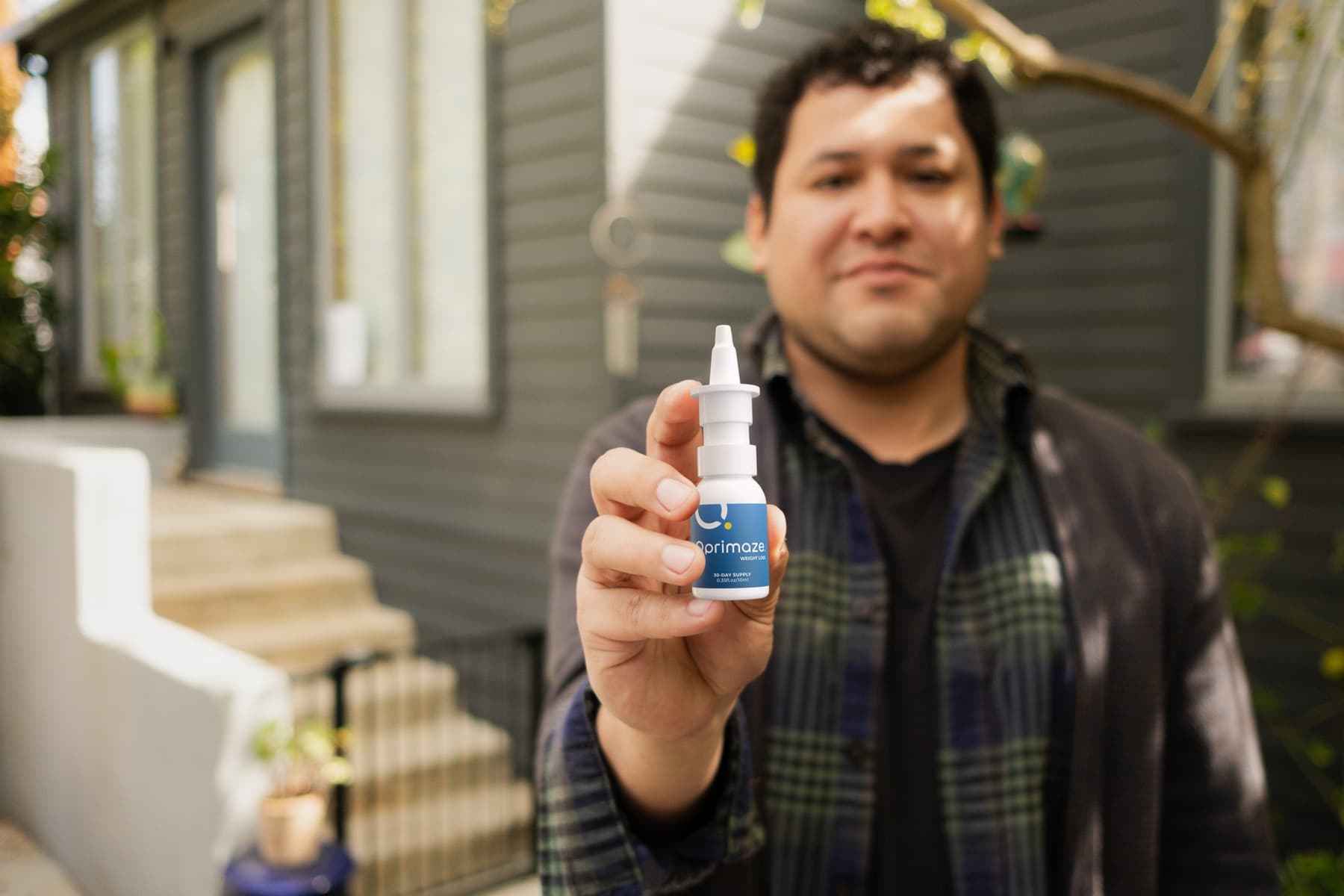
In real hands
A ritual that's easy to keep.
The best plan is the one you keep doing. No needles to dread, no prescriptions to renew — a format designed to make daily consistency easier.
User stories
Real journeys, in their own words.
Names abbreviated. Stories shared with permission. Individual results vary.
“I'd tried two injectable therapies and stopped both because of the nausea. The spray gave me appetite support without making me feel sick.”
“I'd lost the weight twice already and put it back on each time. Phase 02 felt like the first thing actually built for the after.”
“Using both phases together gave me a structure for the whole journey, not just the start.”
Scientific references
Full reference list.
- [1]Wing RR, Phelan S. Long-term weight loss maintenance. Am J Clin Nutr. 2005;82(1 Suppl):222S-225S. PubMed ↗
- [2]Sumithran P, et al. Long-term persistence of hormonal adaptations to weight loss. N Engl J Med. 2011;365(17):1597-1604. PubMed ↗
- [3]Rubino D, et al. Effect of continued weekly subcutaneous semaglutide vs placebo on weight loss maintenance: the STEP 4 randomized clinical trial. JAMA. 2021;325(14):1414-1425. PubMed ↗
- [4]Wilding JPH, et al. Weight regain and cardiometabolic effects after withdrawal of semaglutide: the STEP 1 trial extension. Diabetes Obes Metab. 2022;24(8):1553-1564. PubMed ↗
- [5]Gleason PP, et al. Real-world persistence and adherence to glucagon-like peptide-1 receptor agonists among obese commercially insured adults without diabetes. J Manag Care Spec Pharm. 2024;30(8):860-867. PubMed ↗
- [6]Fothergill E, et al. Persistent metabolic adaptation 6 years after “The Biggest Loser” competition. Obesity. 2016;24(8):1612-1619. PubMed ↗
- [7]Paudel KS, et al. Cannabidiol bioavailability after nasal and transdermal application: effect of permeation enhancers. Drug Dev Ind Pharm. 2010;36(9):1088-1097. PubMed ↗
- [8]Abioye A, et al. Δ9-Tetrahydrocannabivarin (THCV): a commentary on potential therapeutic benefit for the management of obesity and diabetes. J Cannabis Res. 2020;2:6. PubMed ↗
- [9]Jadoon KA, et al. Efficacy and safety of cannabidiol and tetrahydrocannabivarin on glycemic and lipid parameters in patients with type 2 diabetes. Diabetes Care. 2016;39(10):1777-1786. PubMed ↗